Provided By: RockwallNews.com
ROCKWALL – Parents and other
adults dropping off and picking up children from schools should remember that
new state laws go into effect Sept. 1 prohibiting drivers from using mobile
phones on school grounds while vehicles are moving, requiring all occupants in
vehicles to wear seat belts and mandating that all children under the age of
eight or shorter than 4’9″ tall are seated in a proper child safety
seat
The first new law, Section 425.4252 of the
Transportation Code, prohibits the use of a wireless communication device while
operating a motor vehicle on the property of a public elementary, middle, junior
high, or high school for which a local authority has designated a school
crossing zone, during the time a reduced speed limit is in effect for the school
crossing zone, unless: (1) the vehicle is stopped; or (2) the wireless
communication device is used with a hands-free device.
In other words, while school
zone lights are flashing, it is a misdemeanor offense for a driver to use a cell
phone while the vehicle is moving anywhere on
school property—not just on the road in school zones, but also when driving
through the parking lot and drop-off lanes—unless he or she is using a
hands-free device.
The only exception to the law is if the driver must call an emergency
provider, including a family doctor.
Drivers who ignore this new law may face fines up to $200 per offense.
This means drivers cannot text, play games or use the
phone for any other purpose while driving. Passengers may use cell phones for
these various purposes, however, since there are no restrictions for
them.
It is also the responsibility of local governments to post clearly visible
signs as reminders to drivers. If they do not, a citation may then be defended
in court. Remember that the signs might be obscured by foliage or for other
reasons. Limiting cell phone use near schools is the safest way to avoid a
ticket.
If children do not have their seat belts buckled or if they are not in safety
seats, the new law mandates a $25 fine for a first offense and $20 for
additional offenses.
Thursday, September 5, 2013


How to unload a timeshare
Provided By: CNNMoney.com
Whether the resort wasn't the vacation paradise they intended or they simply couldn't afford it anymore, many timeshare owners have struggled to unload properties they purchased during better financial times.
This has created fertile ground for scam artists, who charge thousands in upfront fees to help sell timeshare properties, but rarely facilitate actual sales, the Federal Trade Commission warns.
But you can unload a timeshare without getting stuck in a scam. Just be prepared to lose money on the sale, since resale prices are usually much lower.
Related: Feds crack down on scams targeting timeshare owners
Before attempting a sale, make sure you have all your ownership paperwork as well as details about what and where you own, resort amenities, and fee details. To be able to transfer the title, you should also be current on all payments and maintenance fees.
If you'd like to try selling it on your own, some timeshare management companies or homeowners associations may offer free advertising in a newsletter or website, according to the American Resort Development Association, an industry trade association.
You can also advertise your property for sale on sites like Craigslist or eBay for no or relatively low fees. You can also advertise in real estate or travel sections of newspapers and websites dedicated to timeshare resales, but you may have to pay a bit more. Advertising fees can vary from a few dollars to hundreds, so make sure you understand the cost and for how long your advertisement will run.
If you find a buyer, you will have to go through a process similar to selling a home. In addition to drafting a contract with the purchase details, your buyer may also request the assistance of a closing company to help process the transfer, which will typically cost $300 or more.
Related: Losing money on a timeshare?
You could also try contacting the company that manages or developed your property. Most high-end companies with timeshare properties, such as Marriott or Hilton, will help broker a resale, though you will likely have to pay a significant commission, said Reed Frasa, a New Jersey-based financial planner. Be sure to ask about any restrictions or transfer fees related to selling your property.
Working with a licensed real estate company who can help advertise your property as well as assist in the transfer of the property is another option, but these firms will usually charge commissions of 10% to 30% of the final sale price, according to the ARDA.
If you look for an outside "timeshare resale" service to help you find a buyer, proceed with caution. The Federal Trade Commission warns consumers to only use a reseller who doesn't ask for payment until after a timeshare is sold. Some other red flags, according to the Better Business Bureau, include unsolicited contact from a reseller, claims of eager buyers "waiting in the wings," and promises of a profit.
Some companies also offer services to help frustrated owners donate their timeshares to charity, but this avenue also often requires thousands of dollars in fees. While the companies advertise the prospect of a tax write-off, the amount you can legally deduct as a charitable donation is based on the property's "fair market value," which in saturated markets could be nothing at all
Is there a legitimate way to sell a timeshare? Read in June issue of Money Magazine about a guy in Ohio who sold his at a loss and wanted to claim a capital loss. I'd like to just get rid of mine, regardless of a loss. --Mike, Fort Myers, Fla.
Timeshares give owners joint ownership in vacation properties, often in tropical hotspots like Hawaii or Florida. But on top of purchase costs, the properties typically come with annual maintenance fees and other costs that can add up to thousands of dollars a yearWhether the resort wasn't the vacation paradise they intended or they simply couldn't afford it anymore, many timeshare owners have struggled to unload properties they purchased during better financial times.
This has created fertile ground for scam artists, who charge thousands in upfront fees to help sell timeshare properties, but rarely facilitate actual sales, the Federal Trade Commission warns.
But you can unload a timeshare without getting stuck in a scam. Just be prepared to lose money on the sale, since resale prices are usually much lower.
Related: Feds crack down on scams targeting timeshare owners
Before attempting a sale, make sure you have all your ownership paperwork as well as details about what and where you own, resort amenities, and fee details. To be able to transfer the title, you should also be current on all payments and maintenance fees.
If you'd like to try selling it on your own, some timeshare management companies or homeowners associations may offer free advertising in a newsletter or website, according to the American Resort Development Association, an industry trade association.
You can also advertise your property for sale on sites like Craigslist or eBay for no or relatively low fees. You can also advertise in real estate or travel sections of newspapers and websites dedicated to timeshare resales, but you may have to pay a bit more. Advertising fees can vary from a few dollars to hundreds, so make sure you understand the cost and for how long your advertisement will run.
If you find a buyer, you will have to go through a process similar to selling a home. In addition to drafting a contract with the purchase details, your buyer may also request the assistance of a closing company to help process the transfer, which will typically cost $300 or more.
Related: Losing money on a timeshare?
You could also try contacting the company that manages or developed your property. Most high-end companies with timeshare properties, such as Marriott or Hilton, will help broker a resale, though you will likely have to pay a significant commission, said Reed Frasa, a New Jersey-based financial planner. Be sure to ask about any restrictions or transfer fees related to selling your property.
Working with a licensed real estate company who can help advertise your property as well as assist in the transfer of the property is another option, but these firms will usually charge commissions of 10% to 30% of the final sale price, according to the ARDA.
If you look for an outside "timeshare resale" service to help you find a buyer, proceed with caution. The Federal Trade Commission warns consumers to only use a reseller who doesn't ask for payment until after a timeshare is sold. Some other red flags, according to the Better Business Bureau, include unsolicited contact from a reseller, claims of eager buyers "waiting in the wings," and promises of a profit.
Some companies also offer services to help frustrated owners donate their timeshares to charity, but this avenue also often requires thousands of dollars in fees. While the companies advertise the prospect of a tax write-off, the amount you can legally deduct as a charitable donation is based on the property's "fair market value," which in saturated markets could be nothing at all
Wednesday, August 28, 2013
Take the big stress out of a big move
Provided By: CNNMoney.com
The couple's plan was to be near Boulder, where
they had spent many happy vacations mountain biking and snowboarding. So
Lauren, a personal trainer, and Greg, a communications engineer who
telecommutes, sold their Maryland home, going from listing to a signed contract
in only 10 days.
The Martins' decision to move and the speed
with which they sold their home reflect the rise in mobility accompanying the
country's economic recovery.
With unemployment falling from 10% in 2009 to
7.4% today, and with fewer homeowners carrying underwater mortgages -- 850,000
homes exited negative equity in the first quarter of 2013 -- people are more
willing and able to pick up stakes.
The Census Bureau says nearly 5.1 million
people moved to a new state last year -- up 17% from 2010 and the highest level
since 2006. And as real estate has recovered, demand has outstripped existing
supply: Only 5.2 months' worth of homes were on sale in June, down from 9.4 in
2010.
Related: Where homes are
affordable
So if you're ready to make a long-haul
relocation, you'll have to contend with not only the perennial hassles of
moving -- navigating real estate transactions, packing up possessions, finding
the perfect neighborhood -- but also today's economic conditions.
BRACE FOR TODAY'S
MARKET REALITIES
In most metropolitan areas, potential buyers
far outnumber available homes, according to Redfin. That's great for the
selling part of your relocation, but multiple bids and fast sales make finding
your next place harder. Tight lending rules, moreover, are likely to limit your
flexibility in selling and buying.
Your best moves:
First sell, then
buy... Most lenders today won't extend a
short-term bridge loan if you're trying to buy a new home prior to selling your
current one, says Peter Boomer, executive vice president at PNC Mortgage.
Nor will it be easy to carry two mortgages at
once, says Dan Green, a loan officer at Waterstone Mortgage in Cincinnati.
Should all your debt payments -- the two mortgages, plus any car loans and
consumer debt -- top 40% of your monthly gross income, you'll have trouble
getting approved, he says.
Plan to rent out your old home and buy in your
new town? Green warns that you need at least 30% equity in the old home for
your rental income to be counted on a conventional mortgage application. Even
so, just 75% of that income will be factored in, he says.
... Or rent your new
place. Renting gives you time to get a
boots-on-the-ground feel for exactly where you want to be. It also gives you a
wider choice of starter housing: As you search for the perfect home, you can
settle for a good-enough home without regret, since the compromise will be only
temporary.
The Louisville-bound Martins -- who had always
planned to rent first and buy later -- couldn't find affordable rentals in the
older Boulder neighborhoods they liked most. So as a fallback, they took a
one-year lease in Broomfield, a newer area.
Allow for more time
to look. Whether you plan to buy or rent, expect
plenty of competition during your search. "A long weekend of house hunting
worked in the past, but right now it can take at least a week," notes
Nadya Nahirniak-Hansen, director of relocation services at Madison real estate
agency Restaino & Associates.
USE NEW TOOLS TO
REFINE YOUR SEARCH
A Knight Foundation survey of 43,000 Americans
landed on three basic attributes that make a community lovable: plenty of
entertainment, an inviting vibe, and ample green space. Maybe that's important
to you; maybe not.
To help you focus on what neighborhoods you
like best, Carol Fradkin, author of the bookMoving Gracefully, suggests
compiling a detailed, prioritized list of your family's must-haves. That might
mean great schools, easy access to public transportation, or proximity to a
place of worship.
"The more specific you are about what
matters most to you," says Fradkin (who herself has moved 16 times since
her college years), "the more likely you'll have a smooth and happy
transition." Then, well before you move, you can start looking for your
ideal neighborhood.
Your best moves:
Consult a matchmaker. Hoping to re-create the look and feel of your
current town in your new home? Check out the Match tab at the top of the
NeighborhoodScout.com website. Plug in a place you know and like, and the site
will generate a list of areas in your destination that are the closest matches,
based on 273 factors.
Get a walking tour
from Google's Pegman. In the Street View feature on Google Maps,
drag the yellow Pegman to an address you're checking out. Then click on the
white arrows in the photo to walk the neighborhood. Plug in a destination --
say, the local school -- to get a sense of what the kids' walk would be like.
Learn about headaches
before you commute. Visit the SigAlert.com website for
real-time commuting information for major cities of 37 states and the District
of Columbia. You can get a taste of your drive from maps showing congested
routes, along with live feeds from traffic cams. Another way to learn about
your prospective commute: Listen regularly to the online feed of a local radio
station's rush-hour broadcast.
PICK MOVERS WISELY,
PACK MINIMALLY
Given the average cost to box and ship
possessions for an interstate move -- $5,630, estimates the American Moving
& Storage Association -- it would be nice if everything went smoothly.
Alas, the Federal Motor Carrier Safety Administration, which regulates
interstate moving companies, fielded 28% more complaints last year compared
with 2010.
Some typical problems: Final charges that were
far out of line with estimates, and delays in pickup or delivery. Sure,
unsavory movers are a problem, but even the good guys are under pressure. Les
Velte, president of the Consumers Relocation Services moving company in Weston,
Vt., says many reputable van lines have not hired back all the workers let go
during the financial crisis, making it harder to book a quality crew.
Your best moves:
Shop on reputation,
not price. Get written estimates, yes, but curb your
enthusiasm for the lowest bid, says Michael Garcia, author of Moving
101. And definitely steer clear of companies willing to give you an
estimate over the phone.
"Check references," says Garcia.
"Check their complaint record. That's how you avoid disasters." On
the federal government's ProtectYourMove.gov website, you can search for
movers' safety records and complaint history. Your local Better Business Bureau
is another important reputation check.
Avoid crunch time. If you're flexible, move during the
October-March off-season to increase the odds you'll get a more attentive crew.
"Movers are human," says Velte. "If they are go-go-go from April
through July, by the time your move rolls around in August they can be
exhausted." Movers are also more likely to hire less experienced temps
during peak months.
Buy third-party
moving insurance. Ask your home insurer whether your goods
will be covered during the move; different policies from the same company may
have different terms. A mover's free coverage is limited to 60¢ a pound per
article, which is woefully inadequate.
Movers also sell full replacement value
coverage, but Garcia recommends buying moving insurance elsewhere. "If
there's a problem, I'd want a third party representing me," he says.
Shop online at movinginsurance.com or
moveinsure.com: A policy with a $1,000 deductible can run about 1% of the total
value of your possessions.
Get the urge to
purge. The fewer possessions you move, the less
you'll pay. Michael Stone, a Portland, Ore., move specialist who works with
downsizing retirees, recommends mocking up room-by-room layouts based on the
square footage of your new home to get a realistic feel of what's not going to
fit.
And push yourself to steer clear of the savior
of indecisive souls: the self-storage facility. Renting a small unit can run
you over $150 a month.
MAXIMIZE YOUR
RELOCATION PACKAGE
Twenty-seven percent of firms intend to
increase the number of workers they relocate this year, up from 10% in 2009,
according to Atlas Van Lines. Should your company be moving you, be aware that
its financial support may be limited: Only about 60% of firms fully reimburse
transferees and only 50% provide that help to new hires.
Your best moves:
Know what's standard. More than 75% of companies give workers
two weeks or less to accept or decline a job transfer. Amid the whirlwind that
such a tight deadline creates, get in writing what is and isn't paid for -- and
start negotiating.
For example, shipping one automobile is
commonly covered, but you could pay at least $500 apiece for any additional
vehicles. Seventy-one percent of companies, reports Atlas, offer a
temporary-housing allowance, typically covering a month at an extended-stay
hotel.
Moving into a very tight market? You might want
to ask for more time or money.
Check the expiration
date on benefits. The package your company offers may
include a home buying benefit such as down payment help or closing costs. If
you intend to rent at first, however, make sure you can still claim the benefit
when you are ready to buy. Unless you negotiate otherwise, these benefits tend
to expire within a year of your move.
Avoid nasty tax
surprises. Because the dollar value of your
relocation benefit counts as income, you can be stuck with a big bill at tax
time. So companies often add a gross-up to your benefit -- extra cash to cover
the taxes you'll owe.
Unfortunately, says David Oltman of the
corporate relocation firm Ineo/Relocation in Wilton, Conn., employers often
underestimate gross-ups. So, he says, get a written promise from your employer
to make another payment if the original proves inadequate. Based on his data,
the tax hit for employees of large corporations averages $20,000 -- a lot of
money better put toward enjoying your new Best Place.
Thursday, August 22, 2013
Mortgage rates hit two-year high
Provided By: CNN.com
The average weekly rate for a 30-year fixed-rate mortgage jumped to a two-year high, Freddie Mac said on Thursday.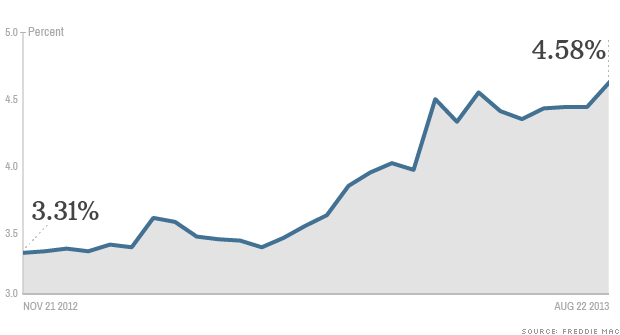
The rate is now 4.58%, up from 4.4% the prior week.
That is the highest level for the 30-year in more than two years, since it hit 4.6% on July 7, 2011, according to Freddie Mac spokesman Chad Wandler. Wandler attributed the increase to an improving housing market. He also cited investor concerns about when the Federal Reserve will taper its government bond-buying program, which could affect interest rates.
Related: How much house can you afford?
Rising rates could also affect the housing market going forward. A recent survey by real estate company Trulia found that an increase in mortgage rates was the prime concerns among 41% consumers, who worried about that more than price increases.
The 30-year rate hit an all-time low of 3.31% on Nov. 21, 2012. Since then, the 30-year has bounced around, sinking back down to 3.35% on May 2, 2013. The runup to the current two-year high has all occurred in the last three months.
Home prices have also been rising.
According to the most recent figures available, the S&P/Case-Shiller home price index was up 12.2% in May compared to a year ago. That was the biggest such jump since March 2006, close to the peak of the real estate bubble.
Related: Calculate your monthly mortgage fee
The recent increase in housing prices has also given rise to concerns of a new housing bubble. But Keith Gumbinger, vice president of the mortgage information web site HSH.com, dismissed those concerns.
"I think it's too early to declare that we're in a housing bubble yet," he said. "We remain well below the peaks of just a few years ago."
He said the housing market is "recovering, and recovering well" but added that mortgage rates of nearly 5% are still historically low.
Related: How much house can you afford?
Rising rates could also affect the housing market going forward. A recent survey by real estate company Trulia found that an increase in mortgage rates was the prime concerns among 41% consumers, who worried about that more than price increases.
The 30-year rate hit an all-time low of 3.31% on Nov. 21, 2012. Since then, the 30-year has bounced around, sinking back down to 3.35% on May 2, 2013. The runup to the current two-year high has all occurred in the last three months.
Home prices have also been rising.
According to the most recent figures available, the S&P/Case-Shiller home price index was up 12.2% in May compared to a year ago. That was the biggest such jump since March 2006, close to the peak of the real estate bubble.
Related: Calculate your monthly mortgage fee
The recent increase in housing prices has also given rise to concerns of a new housing bubble. But Keith Gumbinger, vice president of the mortgage information web site HSH.com, dismissed those concerns.
"I think it's too early to declare that we're in a housing bubble yet," he said. "We remain well below the peaks of just a few years ago."
He said the housing market is "recovering, and recovering well" but added that mortgage rates of nearly 5% are still historically low.
Monday, August 19, 2013
Agghhh!!! Water Rings!
Provided By: Homemademamas.com
Unfortunately this happens all to often (especially if you have children or friends who haven't heard of coasters). You move a hot or cold drink only to find a big ugly water mark on your wooden table. Ughhh! Rebecca found this guy on her coffee table and thought the table was ruined. She tried a trick that had worked in the past, olive oil rubbed over the stain. Nothing. Homemade Nana suggested mayo on it. Nothing. Auntie said she had heard that regular toothpaste would remove a water ring. Again nothing! So we started scouring the internet and found howtogetridofstuff.com . They suggested using a hair dryer or an iron to get rid of water rings. Could that work here? We gave it a try.
 After about 20 minutes the stain was almost completely gone. We put a little olive oil on it to moisturize the wood. The results were amazing!!

Unfortunately this happens all to often (especially if you have children or friends who haven't heard of coasters). You move a hot or cold drink only to find a big ugly water mark on your wooden table. Ughhh! Rebecca found this guy on her coffee table and thought the table was ruined. She tried a trick that had worked in the past, olive oil rubbed over the stain. Nothing. Homemade Nana suggested mayo on it. Nothing. Auntie said she had heard that regular toothpaste would remove a water ring. Again nothing! So we started scouring the internet and found howtogetridofstuff.com . They suggested using a hair dryer or an iron to get rid of water rings. Could that work here? We gave it a try.
We used a blow dryer on high. We held it fairly close to the stain. Slowly it stared disappearing! YEA!!!!
 After about 20 minutes the stain was almost completely gone. We put a little olive oil on it to moisturize the wood. The results were amazing!!
Subscribe to:
Posts (Atom)